


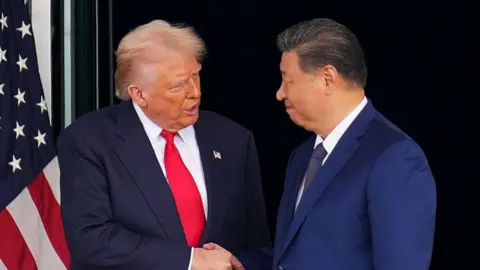
US presidential trips internationally have traditionally been an chance to showcase the influence of the United States on the world stage. The president's five-day swing through eastern Asia, conversely, has been a show of the clout of the leader – but also, at moments, of that power's boundaries.
The president's visits in Malaysia, Japan and Korea over the course of the initial days were an demonstration in satisfying a sometimes unpredictable American president. It was an recognition that the leader, with the signature of a document, could impose duties and additional actions that have the potential to devastate the economies of trade-reliant countries.
His sit-down with China's president Xi on Thursday, nevertheless, was a completely different scenario.
It was a session of equals on the world platform, where the consequences for each country – for their financial health, for their world reputation, for the prosperity of their citizens – were immense.
With China, the US leader may flick his power, but such actions entail repercussions. They involve a toll.
- The US president hails 'impressive' meeting with the Chinese leader but no trade deal reached
- The Chinese president and the US leader establish temporary truce as China pursues extended strategy
For the opening segment, Trump's recent foray into global diplomacy was uneventful.
Each stop was marked by a combination of traditional economic talks – agreements made under the shadow of Trump's "reciprocal" tariffs – and personal accommodations that at times bordered on the obsequious.
In the Malaysian stop, the president secured rights to essential resources and made progress toward completing trade arrangements with south-east Asian nations. He also led a treaty that should alleviate territorial disputes between Thailand and Cambodia – the kind of "truce" the American president loves to highlight.
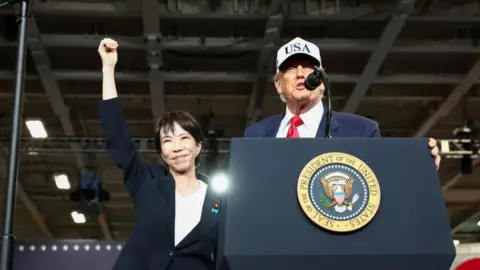
In the Japanese leg, Trump's official aircraft soared near a landmark tower displayed American colors – with a peak in golden.
Freshly appointed Prime Minister the Japanese leader outlined $550bn in Japan's financial commitments in the US and offered the American president a gift of 250 sakura trees for America's 250th anniversary, and a golf club and case that came from the late leader, the killed past head who bonded with the president in his previous administration.
She also became the latest foreign leader to nominate the president for his long-sought peace award.
Keeping pace, the Korean government welcomed Trump with guns performing a honor salute and a armed forces orchestra that performed Hail to the Chief and YMCA – the band anthem that has evolved into a presidential event theme.
Leader the Korean president held an "award event" for the US leader during which he awarded the American leader his nation's top honor and a copy of an historical royal headpiece.
Midday meal with Lee featured a "Peacemaker's Dessert" of gilded chocolate squares. Subsequently, the hosts offered Trump fine beverage at an intimate dinner in the president's recognition with multiple global figures present at the Asia-Pacific Economic Conference conference.
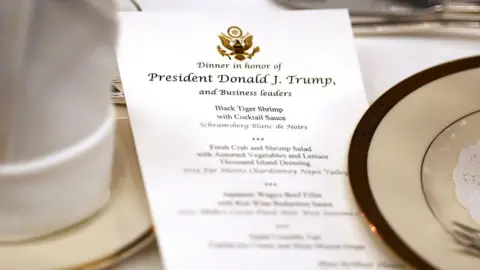
In the America, the president may be the focus of "Anti-Monarchy" rallies by US citizens who disapprove of his limit-pushing increases of executive authority, but during his Asian swing he was handled as royalty.
And like the monarchs of old, Trump visited the Korean nation seeking tribute – in the form of $two hundred billion in cash payments, $twenty billion a per year, from South Korea to the US, to be allocated at the discretion of Trump's administration. Agreement on the details of those payments assisted in that the tax percentage on South Korean goods to the United States would fall from twenty-five percent to 15%.
The primary focus of the president's Asian tour took place in its last moments, however, as he encountered Xi.
At that location, the authority balance between counterparts of the planet's biggest economic powers was decidedly distinct than the exchanges the president had with his foreign counterparts in prior visits.
Missing were typical ceremony and the pageantry. No military bands, without ceremonial troops, without meticulously designed menus celebrating bilateral friendship. By contrast, the pair of counterparts and their top aides sat across a large pale meeting furniture in a plain service structure just adjacent to the landing strip of the city of Busan's international airport.
It was likely a indication of the high stakes that when the president made contact with Xi in the southern port, he seemed

